
smoke grenades (hc smoke)
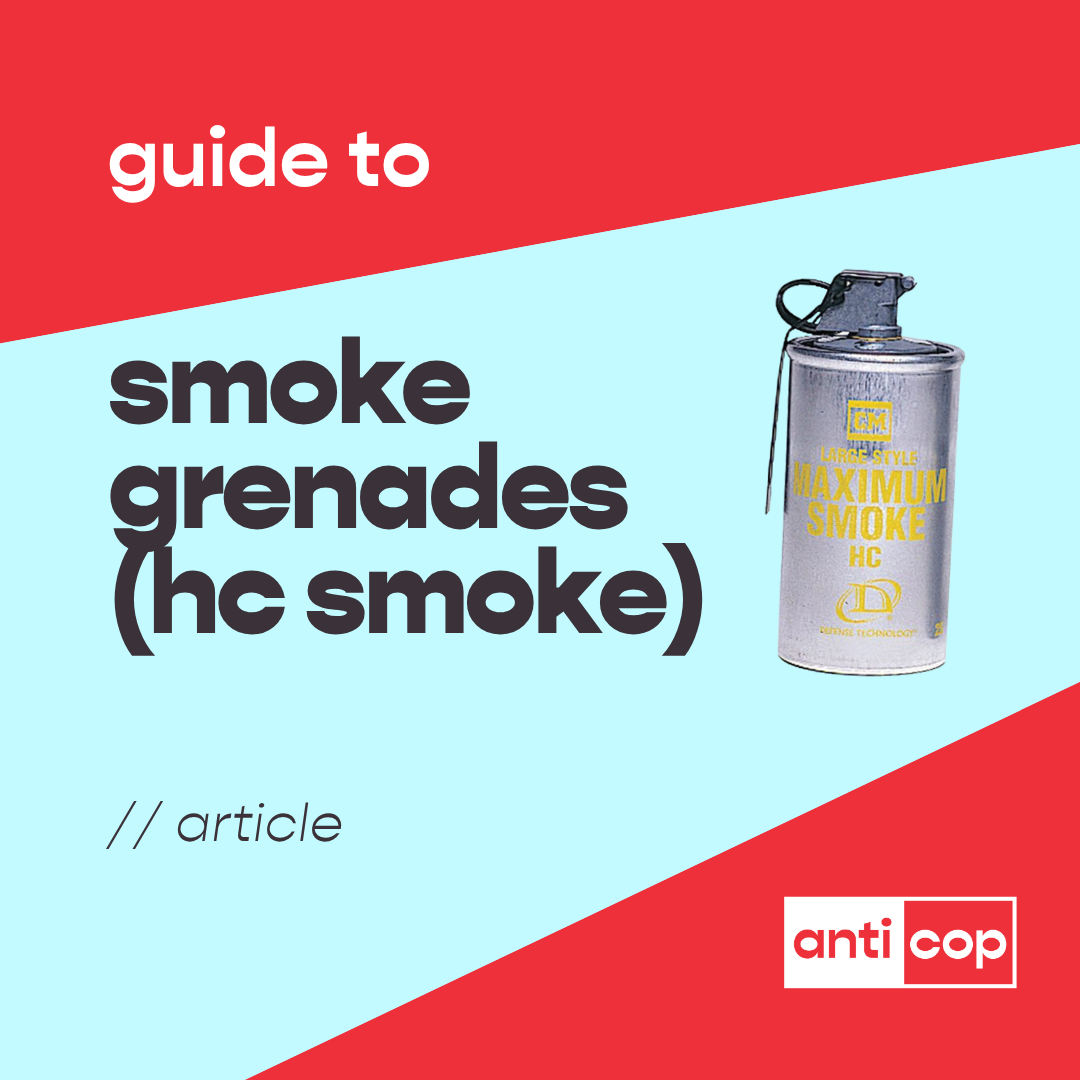
Smoke grenades are single-use devices used by police to create clouds of toxic gas that obscure vision. This can be used to hide police movements, create a distraction or disorientate victims. Increasingly, police use smoke grenades containing hexachloroethane (also called HC, HCE or perchloroethane) as a “less lethal” weapon for crowd control. Chemicals produced by these grenades can cause severe injury or death.
In a military context, smoke grenades may be used as visual markers to send signals to other soldiers, with different colours to differentiate messages.
While smoke grenades for military use feature a variety of designs and chemicals, this article focuses on the HC grenades used by police forces.
Smoke grenades are metal canisters that can be thrown, or fired with a grenade launcher/riot gun. Typically they release gas through emission ports for up to two minutes (1, 2). Smoke grenades are distinct from smoke bombs, pyrotechnic devices that emit a much shorter burst of smoke.
HC grenades contain hexachloroethane (C2Cl6), zinc oxide (ZnO), and granular aluminium. Upon ignition, the chemicals react to produce zinc chloride (ZnCl2) smoke (3). In addition to zinc chloride, smoke grenades produce carbon monoxide, aluminium oxide, and small amounts of other chemicals including gaseous iron, lead and phosgene (COCl2).
HC smoke is generally grey-white. Smoke grenades with less dangerous chemicals may appear in other colours such as green (4). HC canisters have been found in the vicinity of green smoke, but it is unclear if the green smoke itself was produced by HC grenades or a different chemical used at the same protest (5, 6).
a brief history of smoke grenade use
HC smoke grenades were developed by the US Chemical Weapons Service in the 1930s, then used extensively throughout World War II (7).
Between War II and the 1990s, dozens of soldiers, firefighters and civilians were injured or killed after exposure to HC smoke (8).
In 1998, a smoke grenade was mistakenly set off in a stairwell during a US Bureau of Prisons training exercise. Nine guards were injured, leading to a personal injury case against the manufacturer Defense Technology (a subsidiary of Safariland), which was settled in 2008 (9).
After the lawsuit was settled, Defense Technology scrubbed references to toxic chemicals such as hexachloroethane and zinc chloride from their smoke grenade data sheet, though the grenades still produce these chemicals (10).
Due to concerns about the toxicity of HC smoke, as of 2012 US Army had stopped producing HC grenades, and was developing less toxic smoke grenades (11).
In 2020, US Department of Homeland Security (DHS) forces deployed HC smoke grenades against Black Lives Matter protesters in Portland, Oregon (12).
Throughout 2025-2026, the DHS again deployed smoke grenades against anti-ICE protestors in Portland (13, 14).
dangers
Hexachloroethane, zinc chloride and other chemicals produced by smoke grenades are hazardous. The chemicals primarily enter the body through inhalation, but can also damage skin and eyes.
HC exposure can cause vomiting, breathing difficulties, coughing up blood, drowsiness, nosebleed and unconsciousness (15). Symptoms may occur immediately, or develop in the days after exposure. Zinc chloride can burn skin, and the smoke may cause permanent nerve damage, affecting the victim's sense of smell and vision if it makes contact with the nose or eyes (16).
In some cases the smoke can result in death, primarily from fluid buildup in the lungs leading to oedema (swelling) or acute respiratory distress syndrome (17).
The majority of reported injuries have occurred in enclosed areas or buildings that prevent the smoke from dispersing (18).
Hexachloroethane is a likely human carcinogen (19). This is based on animal studies, with more research needed on the relationship between Hexachloroethane exposure and cancer in humans.
HC smoke may cause liver damage (20).
The chemical reaction makes smoke grenades extremely hot. They can cause burns if handled, and may start fires.
countermeasures
HC is less commonly deployed than other chemical weapons like tear gas and oleoresin capsaicin, so there is less academic research and activist experience to draw upon. Military research recommends that anyone handling these grenades should wear protective masks (21).
Protesters can distinguish HC from tear gas by hexachloroethane’s camphor-like scent (similar to menthol or eucalyptus as opposed to CS or OC which smell spicy or peppery). Dispensed canisters may be labelled as HC, rather than CS or another chemical colloquially called tear gas. Smoke grenades produce thicker, longer lasting clouds than tear gas.
Countermeasures should be similar to those deployed against tear gas, with extra emphasis on protecting the skin, and full face-respirators with appropriate filters.
Thermal imaging cameras can allow protesters to see police activity through smoke, but these are expensive and may not be practical in most situations.
preparation
● Wear clothing that covers as much skin as possible.
● A full-face respirator (Eg. Australian P3 rating, US P100) provides the best protection. If this is not available, a P2 respirator will provide partial protection. A cloth soaked in water placed over the nose and mouth will provide minimal protection.
● If you don’t have a full-face respirator, wear goggles to protect your eyes. Swimming goggles and sealed safety goggles may be effective against HC smoke, but do not protect from impacts like punches or baton rounds. Ballistic goggles provide the best all-around protection.
● Avoid “vented” anti-fogging goggles, as the vents allow smoke in. Wear a bike helmet to protect against grenades and other projectiles.
● Avoid wearing contact lenses as particles can lodge between the lens and your eye.
If a smoke grenade lands near you:
● If you don’t have a gas mask and goggles, hold your breath and immediately move away.
● Smoke grenades can be thrown back at police, but they may be extremely hot and you may be charged with “assault police” or similar. Gloves, slings, or other devices should be used to avoid burns. Pit or barbecue gloves are designed to handle hot food, but you may still be burned if you hold the canister for too long.
● Some activists have dispersed tear gas with leaf blowers (22) which would possibly be effective against HC smoke.
first aid
● A person affected by HC smoke should be moved into an area with fresh air. If the victim is conscious, they should sit upright. Ask if they have asthma or other respiratory issues, and offer water to drink (23).
● Call an ambulance if the victim has pre-existing respiratory issues, they inhaled smoke in an enclosed area, or if they lose consciousness.
● Remove contact lenses. Loosen clothes around the neck and chest, and remove contaminated outer layers if possible.
● If the victim is unconscious, place them on their side in the recovery position. If they are not breathing, perform CPR (24).
● Flush eyes with water but be careful not to just spread the substance around. Pour water over one eye at a time.
● Use water or dampened wipes to wash the substance from the victim’s skin and hair.
references
(1) MP-2S-HC - SMOKE GRENADE (nonlethaltechnologies.com)
(2) MAXIMUM COVERAGE HC SMOKE GRENADE LARGE STYLE – CONTINUOUS DISCHARGE (defense-technology.com)
(3) Chemical Obscurant Smokes - Physicians for Human Rights
(4) Chemical Obscurant Smokes - Physicians for Human Rights
(6) What’s the Deal With That Scary-Looking Green Gas ICE Is Using in Minneapolis? | Mother Jones
(9) Police Deployed Potentially Lethal Chemical During Black Lives Matter Protests | Truthout
(11) Army labs join forces for healthier smokes | US Army
(13) Update on chemical munitions use near ICE facility (portland.gov)
(14) The US Government Keeps Using Dangerous Chemicals on Protesters – Mother Jones
(22) Portland protesters counter teargas with leaf blowers in standoff with federal troops (youtube.com)
(23) Material Safety Data Sheet - Hexachloroethane, 99% (https://pim-resources.coleparmer.com)