
flashbangs
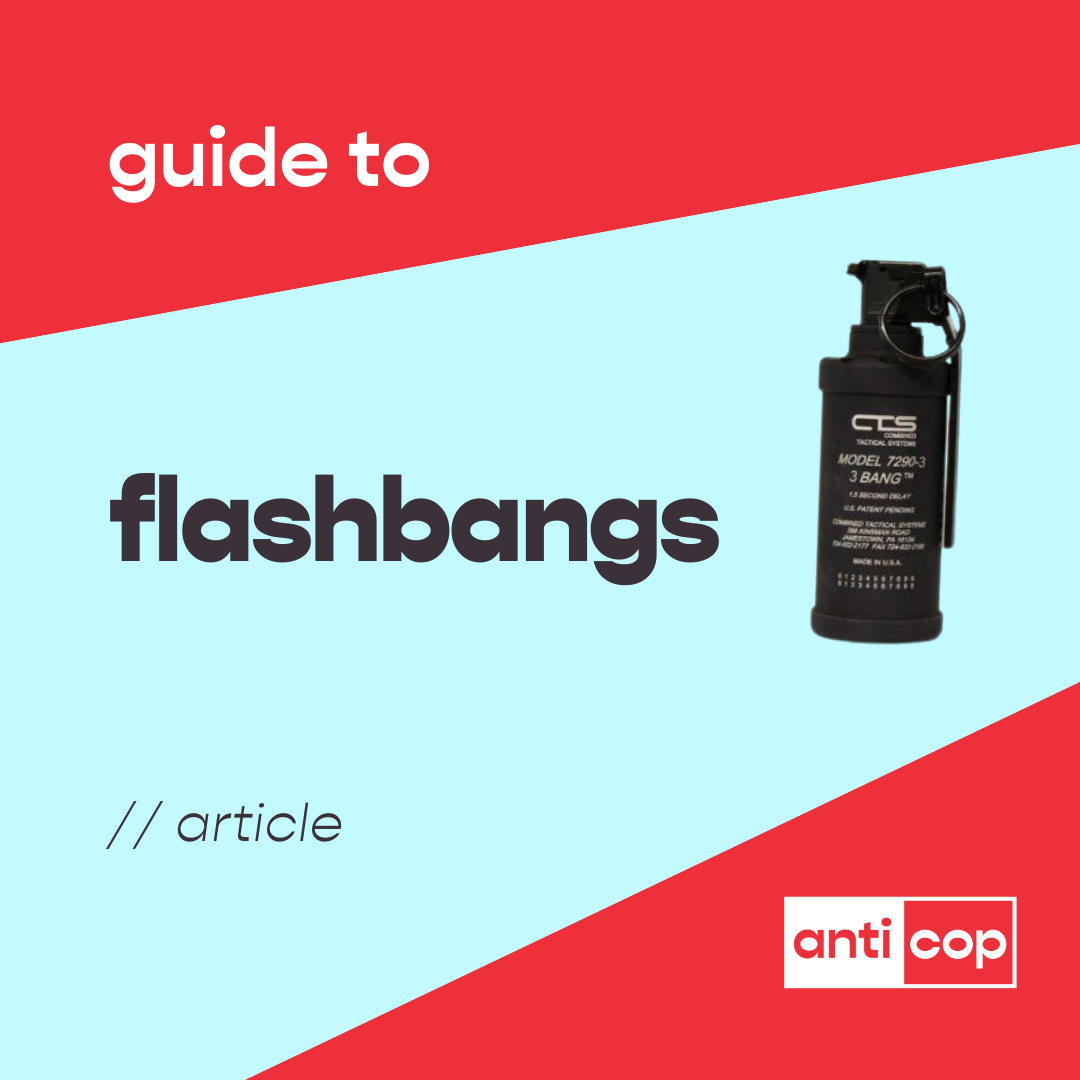
Flashbangs (also called stun grenades, or noise/flash diversionary devices) are single-use weapons thrown or fired into proximity of the victim, which then emit a deafening sound and flash of light. Police use flashbangs to overwhelm their victims’ senses, rendering them vulnerable to further attack.
Flashbangs are sometimes grouped in the broad category of “disorientation” or “distraction devices” along with concussion grenades, blast balls/stinger grenades and lasers. These weapons are aimed at disorienting their victims, and in some cases are also aimed at physically injuring the victim eg. blast balls.
Flashbangs may be thrown as grenades, or fired into the air via a grenade launcher/riot gun to deploy above the victim’s head.
Thrown flashbangs typically operate with a ring-pull leading to a 0.5-1.5 second delay before deflagration. Some models continue to produce explosions after being thrown (eg. 6 “flash bang actions” at irregular intervals of roughly 0.5 seconds) (1).
Flashbangs contain a metal such as magnesium or aluminium and an oxidiser such as potassium perchlorate. When activated, the chemical reaction produces and explosion reaching up to 3000 degrees Celsius (2), sounds of 170 decibels (3), and flash up to 13.5 million candela (4).
Flashbangs generally have a hard steel or aluminium outer shell that is designed to stay intact during the explosion, unlike a fragmentation grenade. This is not always successful, and shrapnel can fly out of the flashbang.
Hot gas, light, sound and the shockwave are released through venting ports. Venting ports can be located across the body of the grenade giving it the “classic” flashbang appearance (eg. M84 Stun Grenade) (5) or in the base and lid of the canister (6).
history
During World War 2, the British Army used “thunderflash” devices in training, designed to mimic the sound and look of an explosion without causing significant damage.
These devices evolved into the modern flashbang during the 1960s, for use by the British Army Special Air Service (SAS) Counter Terrorist Wing (7).
In July 1976, Israeli forces may have used a flashbang during the rescue operation of a hijacked plane in Entebbe, Uganda.
Flashbangs came to public attention in 1980 with the SAS assault during the Iranian Embassy Siege in London, when an SAS flashbang caused a fire in the embassy, burning one of the soldiers (8).
Flashbangs continued to see use in the military, and spread to tactical police throughout the 1990s. Today they are increasingly used for crowd control.
dangers
Despite police claims that flashbangs are “less lethal” and “distraction” devices, these weapons frequently injure and kill their victims. Flashbang blasts can cause severe burns, shrapnel wounds, and can knock victims to the ground resulting in injuries.
Sounds above 140 decibels are unsafe for any period of time, causing pain and potential permanent hearing loss (9). Flashbangs produce sounds around 170 decibels (10).
Flashbangs have caused injuries requiring finger (11) and hand amputations (12).
Aerial flashbangs fired from a grenade launcher or riot gun can be lethal if fired directly at the victim, similar to other baton rounds (13).
If a flashbang lands on a soft or wet surface like sand or mud, the venting ports may be blocked. This can cause the flashbang to launch into the air (14).
Flashbangs can harm police themselves, such as Charlotte-Mecklenburg police officer Fred Thornton who died in 2011 after accidentally setting off a flashbang in his home (15).
Flashbangs can blind officers, affecting their accuracy or giving them a plausible excuse for violence.
In 2010, Detroit police threw a flashbang into the home of 7 year old Aiyana Jones as she slept on the couch. The flashbang lit her blanket on fire. Officer Joseph Weekley then fired one shot, hitting Jones in the neck and killing her (16). He later claimed the flashbang obscured his vision (17). The police were targeting a suspect in an apartment the floor above Jones.
Flashbangs may start fires which then lead to burns and smoke inhalation, which is especially dangerous for children.
In 2014, police in Cornelia, Georgia (USA) executed a no-knock warrant at the Phonesavanh family home based on a suspicion of methamphetamine dealing. Police threw a flashbang into the cot of 1 year old “Bou Bou”, lighting a fire causing severe injuries to the baby including burns and lacerations to the face and chest, exposing his ribs (18). He was placed in a medically induced coma and required over $1 million USD of surgery (19). No drugs were found in the home.
In 2022, police in Albuquerque repeatedly tear gassed, and fired pepper balls into a home aiming to render the air unbreathable and flush out Briant Kelly, who was wanted for failing to report to a parole officer. 15 year old Brett Rosenau was also in the home. Officers threw flashbangs inside which started a fire, badly burning both Rosenau and Kelly (20). Rosenau died from smoke inhalation (21).
countermeasures
Protective equipment can reduce the effects of flashbangs, but will not completely protect you.
Unfortunately, flashbangs are often used in surprise attacks. Unless you are wearing protective equipment preemptively, you may not be able to don it in time.
Sunglasses will provide minimal protection against the flash. Welding helmets and industrial goggles can be more effective. Tinted, non-vented ballistic goggles provide some protection against flashbangs, as well as baton rounds and chemical irritants such as tear gas and oleoresin capsicum.
Wearing a combination of expanding foam earplugs and over-ear protection will provide the best hearing protection.
When choosing hearing protection, find the highest standard available in your country (for example in Australia and Aotearoa/New Zealand, look for AS/NZS 1270:2002, Class 5).
If you see a flashbang that is about to detonate, turn your body away from it to minimise its effects.
Fire blankets and extinguishers can be used if the flashbang starts a fire.
Treat flashbangs on the ground with extreme caution. They can stay hot after deflagration, and may still explode. Keep your distance from these flashbangs, and if you must handle them do so with heat-resistant gloves.
references
(1) Model 7290-6 Multi 6 Flashbang Product Specifications (combinedsystems.com)
(2) Disorientation Devices (lethalindisguise.org)
(3) Noise Flash Diversionary Device CTS 7290 Appendix (ojp.gov)
(4) US8161883B1 - Flash-bang grenade with greater flash intensity | Google Patents
(5) XM84/M84 Stun Grenade: Design, Use, and Potential Risks (combatoperators.com)
(6) Noise Flash Diversionary Device CTS 7290 Appendix (ojp.gov)
(7) Disorientation Devices (lethalindisguise.org)
(8) Operation Nimrod: Iranian Embassy Raid Raised SAS Profile | Business Insider
(9) Loud Noise Dangers (asha.org)
(10) Noise Flash Diversionary Device CTS 7290 Appendix (ojp.gov)
(12) OLD SKILLS RELEARNED: Taking aim once again | Northwest Arkansas Democrat-Gazette
(13) Model 4090-50 40MM Aerial Flash–Bang (Combined Tactical Systems)
(14) Model 7290-6 Multi 6 Flashbang Product Specifications (combinedsystems.com)
(15) Update on accidental flashbang death of Fred Thornton | Police1
(16) Girl, 7, asleep when shot by Detroit police: family | CBC News
(17) How A Police Officer Shot A Sleeping 7-Year-Old To Death | HuffPost
(18) Door-Busting Drug Raids Leave a Trail of Blood | The New York Times
(19) Family of Toddler Injured by SWAT 'Grenade' Faces $1M in Medical Bills | ABC News
(21) 15-year-old dies from smoke inhalation during police standoff | WDBJ 7