
kettling
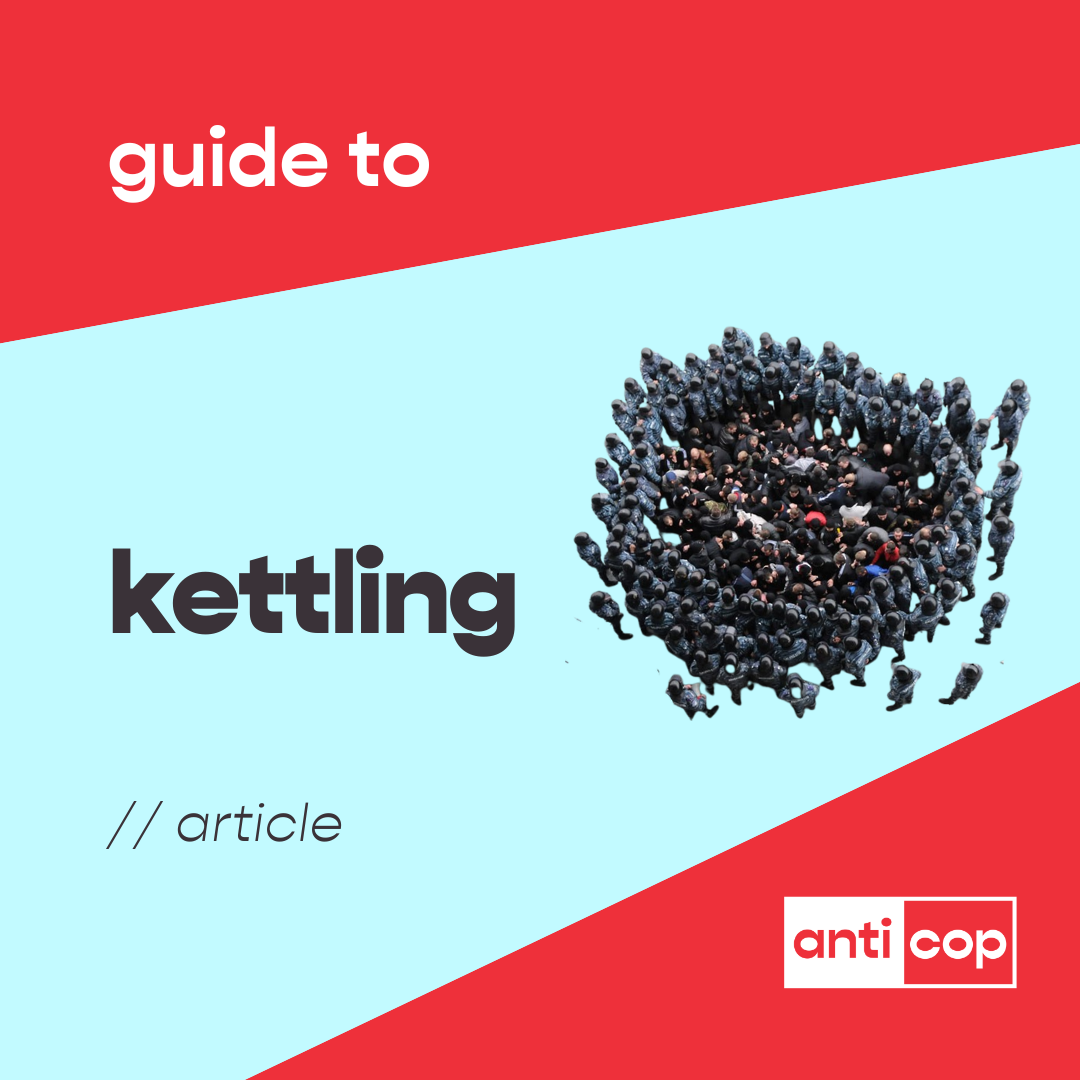
Kettling (Referred to by police as corralling or containment) is the crowd control tactic of surrounding a group of protesters and containing them for an extended period. Like boiling water contained within a kettle, police claim that kettling contains volatile elements of a crowd so that they cannot harm anyone or damage property. In practice, it provokes confrontations, allowing police to use greater violence against the crowd.
Once police have kettled a group, they may prevent all protesters from escaping, or may release small numbers at a time, or pick off individuals for arrest.
Kettling can be stationary or mobile. Surrounding a large crowd in the open requires large numbers of police, so police may herd the crowd into a narrow street or other area where it can be contained. Bridges, buildings, barricades, vehicles and horses can assist in containing a group.
Kettling can be sustained for hours, leaving protestors without access to food, water, toilets or medical care.
Kettling features in crowd control strategies like “Command and Control” or “Strategic Incapacitation”, with police targeting particular political factions or perceived leaders. While police crowd control strategy often aims to disperse crowds, kettling controls movement in the opposite way.
Advocates claim kettling calms protesters down and uses “boredom” rather than fear (1). In practice, this is not the case. People become panicked when trapped, and constant pushing from police can lead to protesters pushing back, creating an excuse for police to escalate violence against the encircled group.
Academic Mark Neocleous states:
“The threat contained in the kettle is a threat produced by the kettling. The kettle fabricates the very crowd that the police need to contain; the police power creates the collective threat to be contained.” (2)
history
Envelopment or encirclement has been an established tactic throughout military history, ranging from isolating individual units to entire armies as in the Battle of Cannae (3). Encirclement prevents retreat and resupplying and allows the attacked to concentrate force while many of the encircled soldiers are unable to reach the front lines. The German word for this tactic Kesselschaft (cauldron/kettle battle) is the likely origin of the English term kettling (4).
On 8 June 1986 German police contained 861 anti-nuclear protesters in Hamburg for several hours, with the media referring to the tactic as kettling (5).
Kettling as a police tactic was developed primarily in England in the 1990s, before becoming a common tactic worldwide in the 2000s particularly at anti-globalisation protests. Kettling can be seen as a reaction to emerging decentralised protest tactics of the time (6).
dangers
Kettling places its victims in a vulnerable position where police violence is more likely and effective, and the basic physical needs of victims cannot be met.
Kettling cuts off food, water and medical supplies, and can cause prolonged exposure to the elements. This is particularly risky for people with a medical condition or disability.
Protests organised during the COVID-19 pandemic, protest organisers have tried to facilitate social distancing, which kettling prevents by forcing people into close proximity (7).
Kettling can cause injuries from falls and crowd crushes (8).
People who are kettled can be more easily targeted with “less lethal” weapons. For example, on 6 June 2020, a group leaving a Black Lives Matter protest were kettled in Sydney’s Central Station. Police used the corridors of the station to trap their victims, before deploying pepper spray (9).
On 1 April 2009, several protests were organised at the G20 Summit in London. Ian Tomlinson, a man with no involvement in the protests, attempted to navigate his way home through multiple kettles. He was bitten by a police dog and killed with a baton strike (10). At the same protest, police bashed a woman with a riot shield, leaving her bleeding heavily from the vagina in a potential miscarriage. She was kettled for up to five hours and unable to seek medical attention (11).
On 9 December 2010, police kettled protesters in London campaigning against university fee increases. Police struck Alfie Meadows with a baton, fracturing his skull and causing a brain bleed that required surgery to save his life (12).
legality
Kettling involves the mass detention of protesters who may not be suspected of a crime, and even bystanders. Depending on the jurisdiction, this may conflict with freedom of movement and police arrest powers. Legal challenges to kettling have had mixed success.
In 2009, the United Kingdom House of Lords ruled that kettling tactics used in London in 2001 were lawful (13). This was confirmed in an appeal to the European Court of Human Rights in 2012. The case was brought by a protester and three bystanders who were kettled for seven hours at an anti-globalisation protest (14).
In 2011, the United Kingdom High Court ruled that kettling at the 2009 G20 protests (where police killed Ian Tomlinson) was illegal, but this decision was overturned on appeal in 2012 (15).
On 4 June 2020, New York police kettled a group of Black Lives Matter protesters, attacking the crowd with batons and pepper spray. At 8:06 PM, protesters were told if they remained in the area they would be in violation of a curfew that had started at 8 PM. Protesters had been surrounded before 8 PM, and were unable to leave because of the kettle. Protesters were then mass-arrested for violation of the curfew (16).
In 2024, protesters who had been kettled reached a settlement with the New York Police Department providing compensation and agreeing not to kettle protesters without first providing a warning or opportunity to leave the area. The settlement was opposed by the Police Benevolent Association (17).
Even where kettling has been deemed lawful, courts have ruled that it must be proportionate. For example, the European Court of Human Rights stated:
“It must be underlined that measures of crowd control should not be used by the national authorities directly or indirectly to stifle or discourage protest, given the fundamental importance of freedom of expression and assembly in all democratic societies.” (18)
countermeasures
The best approach to kettling is to avoid it, while taking measures to mitigate the harm if you are kettled.
Generally try to keep your protest mobile, avoid being boxed in, and consider splitting into groups or stage multiple actions to stretch police resources. This approach can be summarised by the 2019 Hong Kong protest slogan “Be Water” - taken from Bruce Lee’s fighting style (19).
Consider the terrain when planning a protest. A march route with chokepoints creates opportunities for a police kettle. If you’re rallying in one location, does it have multiple escape routes?
Plan a rendezvous point in case your group is split up or you need to unexpectedly retreat from a kettle.
To mitigate a kettle, prepare to be held for several hours - carry water, food and medical supplies. Depending on the weather, consider sunscreen, blankets and umbrellas.
Assigning protest roles can help counter kettling. Scouts can see if police are preparing a kettle, marshals can direct the crowd away. If a kettle is successful, legal observers can document police actions, and a police liaison may be able to negotiate an end to the kettle.
Be aware that police lines on either side of the protest do not necessarily indicate a kettle. A kettle requires complete enclosure of a group.
If scouts believe a kettle is forming, they should notify marshals, who will then reverse the direction of the crowd, or disperse and move separately to a rendezvous point.
A group can attempt to escape containment by using a wedge or “flying V” formation, concentrating force with one person at the point of the wedge pushing into the police line, and other protesters all pushing from behind. This approach risks injury and criminal charges.
references
(1) Professor defends 'kettling' technique used at G20 protests | Birmingham Post
(2) Neocleous, M. Kettle Logic. Crit Crim 29, 183–197 (2021) p 194
(3) The Importance of the Battle of Cannae (warontherocks.com)
(4) Neocleous, M. Kettle Logic. Crit Crim 29, 183–197 (2021) pp. 190-191
(5) The mother of all kettles | Die Tageszeitgung
(8) Kettle tactics risk Hillsborough-style tragedy – doctor | The Guardian
(10) CPS statement on the death of Ian Tomlinson | The Guardian
(11) IPCC demands change in police tactics after G20 protests inquiry | The Guardian
(12) I suffered a brain injury at the hands of the police. I am still waiting for justice | The Guardian
(14) European court says 'kettling' tactics in 2001 lawful - BBC News
(15) Met Police wins appeal over G20 kettling tactics - BBC News
(17) Federal judge OKs settlement over NYPD’s protest policing tactics | Courthouse News Service
(18) CASE OF AUSTIN AND OTHERS v. THE UNITED KINGDOM - European Court of Human Rights
(19) ‘Be water’: Hong Kong protesters adopt Bruce Lee tactic to evade police crackdown | The Independent